
By Raimundo Rojas, Outreach & Events Director
National Right to Life
In 2009, America felt tired. Almost 10 percent of the workforce was unemployed, and the housing crash caused work stoppage at many construction sites.
Work dried up. Families stretched groceries, delayed bills, and prayed the next paycheck would come before the next crisis. In South Florida, Mercedes (Mercy) was 30 years old, living with her husband and two small children in an apartment already too small for four.
Her husband had recently lost his construction job. She cleaned offices part-time. He picked up odd jobs when he could find them. Medicaid and food assistance helped keep the family afloat.
Then one day, Mercy knew. A child had begun to grow beneath her heart.
She did not tell her husband. Not at first. He had hope in him, and she thought hope was too expensive. She considered herself the practical one. Another baby, she told herself, would break them.
She had seen the billboards for abortion clinics in her neighborhood. With help from a neighbor, she made an appointment and went.
Then came the answer. They would not take Medicaid.
Cash only. Money she did not have.
Mercy could not take that much from the family’s already thin funds without telling her husband. And she knew he would never agree to pay for an abortion. So she went home carrying a secret and a child.
A few days later, over a dinner consisting of leftovers, she told him.
He smiled.
He believed they could make it. He believed work would come. He believed this baby belonged in their family.
Because of the Hyde Amendment, that child lived and goes to school with my grandson.
Mercy did not know Hyde’s name then. She did not know Congress had first enacted it on September 30, 1976, to stop federal Medicaid dollars from paying for elective abortions. She did not know pro-lifers had spent decades defending it. She knew only that Medicaid would not pay for the abortion she thought she needed.
Years later, by happenstance, Mercy met my daughter, and the two became friends. Over time, they’ve grown close, crossing paths at birthday parties, high school graduations, and the kind of family gatherings where people start as acquaintances and slowly become part of one another’s lives. She knew what I did for work. She knew where I stood on abortion and on helping women in crisis.
One day, toward the end of a multi-family barbecue, and out of the proverbial blue, she sat next to me on a bench in the cul-de-sac where my daughter lives and told me her story. She searched my face for forgiveness, but forgiveness is not mine to give. I grabbed her hand and pointed to where the teenagers had gathered, and just said, “Look, It’s all good.”
After a moment, I told her about Henry Hyde. I explained that a law she had never heard of had helped protect her daughter’s life. She listened quietly. When I finished, she paused, looked up at me, and said only, “Que Dios lo bendiga.”May God bless him.
A policy written in Washington in the 1970s. A mother in South Florida. A father at a kitchen table. A daughter attending the same prom as my grandson. Two families standing in the light of a life that almost disappeared before anyone outside the womb had met her.
That is the quiet power of the Hyde Amendment.
Now reason must speak clearly.
The Hyde Amendment saves lives because taxpayer funding changes abortion decisions. When Medicaid pays for abortion, more abortions occur. When it does not, many women carry their children to term. Mercy’s daughter is not an exception to the rule. She is the rule with a face.
For 50 years, Hyde has barred federal funding of elective abortion in Medicaid, except in limited cases. Because Congress must renew Hyde through the appropriations process, abortion advocates have attacked it again and again through budgets, health care bills, campaign platforms, and repeal efforts.
National Right to Life has stood at the center of the fight to protect Hyde. NRLC helped win it, defend it, and alert the country whenever pro-abortion forces tried to force taxpayers back into the abortion business.
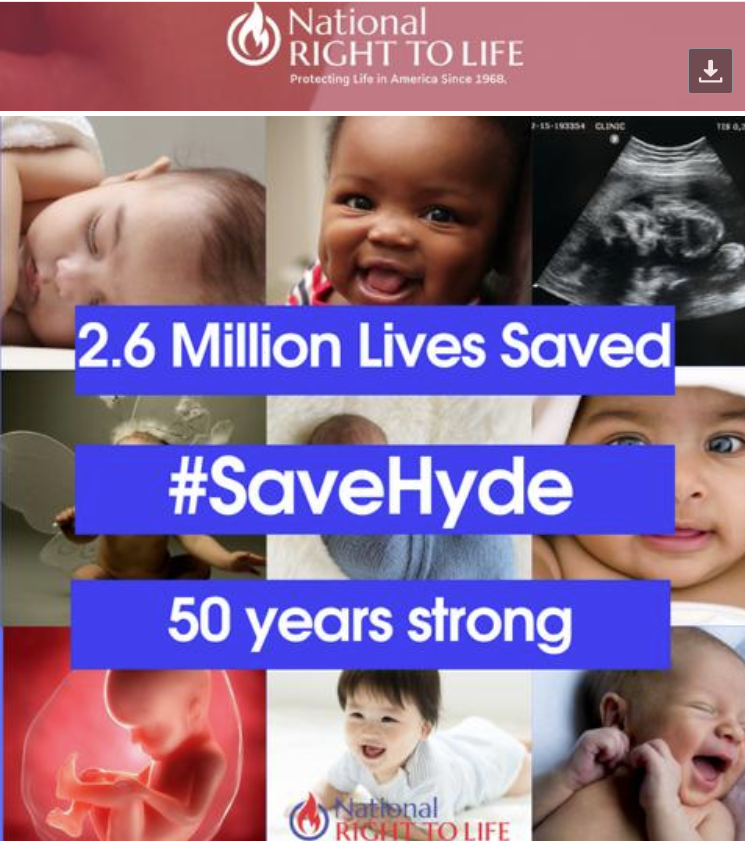
The result is staggering. The Hyde Amendment has saved more than 2.6 million lives since 1976.
More than 2.6 million children.
That number can feel too large to hold in the mind. So bring it back to Mercy’s daughter. One child spared. One mother who lived to rejoice in the daughter she feared she could not carry. One father who welcomed a baby when the economy told him to despair. One girl who grew up, laughed, learned, danced, and became impossible to imagine life without.
Now multiply that mercy by more than 2.6 million.
Hyde protects unborn children. It protects taxpayers from forced participation in abortion. It also gives many frightened mothers what the abortion industry tries hardest to take from them: time. Time to breathe. Time to tell the truth. Time to find help. Time for fear to loosen its grip.
As we mark the 50th anniversary of the Hyde Amendment in a couple of months, we honor more than a policy. We honor the children who live because the great Henry Hyde stood firm. We honor the mothers who found courage after fear. We honor the pro-life advocates, led for decades by National Right to Life, who fought battle after battle to keep this protection in place.
Mercy’s daughter is not a statistic.
She is the reason.