
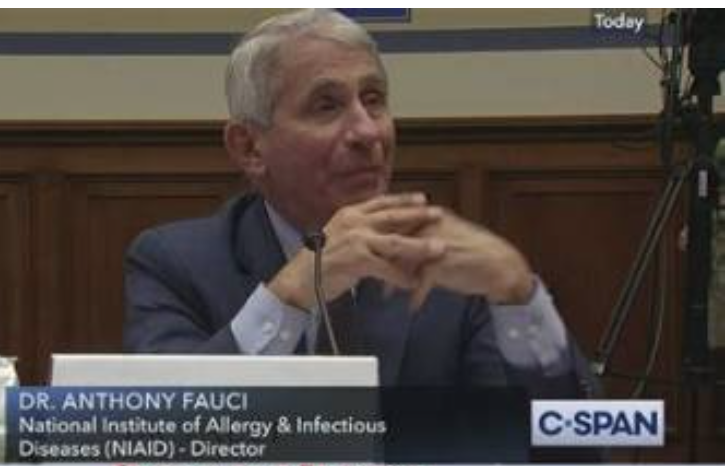
Fauci, Walensky, and the uncomfortable gap between private uncertainty and public reassurance
By Lynda Bell, President
Florida Right to Life
There are moments in public health when the difference between “we know this is safe” and “we do not yet have enough information to know” matters enormously.
Pregnancy is one of those moments.
A pregnant woman is not merely making a decision for herself. She is making a decision while carrying another human being. When the evidence is incomplete, honesty about uncertainty is not a luxury, it is the minimum standard.
That is why the newly released COVID era communications involving Anthony Fauci, Rochelle Walensky, and Vivek Murthy deserve serious scrutiny.
The issue is not whether “every” miscarriage reported after vaccination was caused by a vaccine. The issue is whether pregnant women were given an appropriately candid picture of what officials actually knew, what they did not know, and what they privately worried might happen.
And on that question, the record is considerably more complicated than the reassuring public slogans suggested.
In January 2021, Fauci was privately discussing the problem of vaccinating women during pregnancy with Walensky and Murthy. The newly released messages show Fauci raising a specific theoretical concern: “fever and the inflammatory response following a second dose might, in theory, be associated with miscarriage during the first trimester”.
Walensky acknowledged that the point was worth considering stating. “Definitely a good point esp after dose two.”
Then, this bombshell. In a newly released message from Dr. John Mascola, head of The National Institute of Allergy and Infectious Diseases, Vaccine Research Center, telling Fauci that “initial pregnancy studies had avoided first-trimester vaccination because of possible fever and higher miscarriage rates in the first trimester.”
Did you catch that? “They avoided reporting on first trimester vaccination stats because of the “higher miscarriage rates” while most Covid injections were being encouraged in the first trimester!
Nine days later, on February 3, according to JAMA Fauci stated: the FDA had found “thus far no red flags” concerning pregnant women. The deception continued at the expense of precious babies and their pregnant mothers.
Additionally, by late 2021, Rochelle Walensky was telling pregnant women that the CDC “strongly recommended vaccination, while emphasizing that the benefits outweighed known or potential risks. Then, in a September 2021 PBS interview, she said they had “extraordinary safety data…”
This is a disgusting display of a blatant disregard for life and there should be consequences.
This is important because it demolishes the idea that there was “absolutely nothing to worry about.” Combine this with the fact that women of childbearing age had a more than 99.5% rate of total recovery from Covid 19 . There was literally no reason to push the so-called vaccine on pregnant women in the first place.
But there is an equally important fact on the other side of the ledger. The vaccines were initially being used in pregnant women with limited direct clinical-trial data, and the federal government was collecting safety information through surveillance systems such as the Vaccine Adverse Event Reporting System (VAERS) and the Vaccine Safety Datalink. VAERS itself is designed as an early warning system.
While a report following vaccination is not conclusive proof that the vaccine caused the event, one thing is clear, the pregnant women were the trials, they were the experimental guinea pigs.
That distinction matters.
It matters because thousands of adverse-event reports can be emotionally horrifying without establishing causation. It also matters because dismissing every concern simply because causation has not been proven is equally bad science.
Somewhere between those two extremes lies the truth.
And that truth is precisely what pregnant women deserved.
Instead, the public messaging became increasingly confident.
Later public statements became still more emphatic. Officials pointed to tens of thousands of vaccinated pregnant women,saying there was no indication of increased adverse outcomes. That is where the controversy becomes legitimate.
Because the private conversation was not, “There is absolutely nothing here to think about.”
It was, essentially, “There are unanswered questions, here is a theoretical concern, and we need to weigh risks and benefits.”
That is a very different sentence.
And pregnant women had every right to hear the second one.
The historical record also shows why the evidence needed to be treated carefully. The CDC’s archived guidance stated that COVID vaccination during pregnancy was safe and effective, while acknowledging that evidence was continuing to accumulate.
That needs to be said plainly.
But none of that resolves the central ethical question.
Why was the public conversation so much more certain than the private one?
That question becomes even more uncomfortable when we remember how quickly pregnant women were encouraged to accept vaccination as the obvious choice. The official position evolved during 2021 as more safety information accumulated. The CDC did not explicitly recommend COVID vaccination for pregnant women until April 2021, after additional safety data became available, while major obstetric organizations subsequently strengthened their recommendations.
There is nothing inherently scandalous about scientific guidance changing as evidence accumulates.
That is how science is supposed to work.
The scandal would be pretending that the uncertainty never existed.
Science does not require officials to be omniscient. It requires them to be honest.
A pregnant woman could reasonably have been told:
“We do not yet have robust trial data in pregnancy. COVID itself carries risks during pregnancy (this is up for debate) The vaccine may reduce those risks. We are monitoring safety closely. There are legitimate concerns, particularly regarding fever and early pregnancy.”
That statement would have respected both the science and the woman.
Instead, the public discourse frequently drifted toward the language of certainty.
And now, years later, private communications are allowing the public to see something that was considerably messier.
But it does establish something much more useful: officials themselves understood that important questions remained unanswered.
That deserves accountability.
Accountability does not mean inventing evidence to fit an accusation. It means demanding that officials explain their decisions, their communications, their evidence, and the distance between what they privately believed and what they publicly told millions of people.
If those decisions were justified, explain them.
If the evidence supported the messaging, show it.
If the uncertainties were adequately disclosed, demonstrate where they were disclosed.
And if officials knowingly presented unresolved questions as “settled science” because they believed public compliance was more important than complete transparency, then that deserves an entirely different conversation.
Pregnant women were not statistics.
The women who lost their babies were not merely entries in a surveillance database.
Their grief was real. Justice for those women begins with refusing to manipulate their stories in either direction. Their losses should not be exploited to prove a conclusion the evidence cannot support. Nor should their experiences be waved away because acknowledging them makes an official narrative uncomfortable.
There is a particularly bitter irony here.
Officials repeatedly told the public to “trust the science.”
Fine.
Then let us actually trust it.
Let us examine the data, the surveillance systems, the clinical evidence, the internal correspondence, and the public statements.
Let us compare what officials knew privately with what they said publicly.
Let independent investigators determine whether anyone crossed the line from reasonable public-health judgment into negligence, deception, or misconduct.
And if the evidence ultimately demonstrates criminal wrongdoing, then the appropriate response is not internet outrage, political theater or name-calling.
It is prosecution.
If it does not, then we should have the intellectual honesty to say that too.
The victims of the pandemic, and the women who suffered losses of their babies, deserve something better than another partisan shouting match.
They deserve the truth.
And if the truth reveals that powerful officials knowingly concealed material uncertainty while demanding extraordinary trust from pregnant women, then the question should not be whether those officials deserve criticism.
The question should be why they were trusted in the first place.
~~~~~~~~~~~~~~~~~~~~~~~~~~~~~~~~~~~~