
By Dave Andrusko
2026 is the 50th anniversary of the Hyde Amendment, whose life-saving impact (in the words of former National Right to Life Legislative Director Douglas Johnson) “has proven itself to be the greatest domestic abortion reduction law ever enacted by Congress.”
The law, first enacted in 1976 and finally upheld by the Supreme Court in 1980, has conservatively saved the lives of over 2,600,000 unborn children. And what against-all-odds victory that was because in those days, the Supreme Court included such pro-abortion stalwarts as justices William J. Brennan Jr., Potter Stewart, Thurgood Marshall, Lewis F. Powell Jr., John Paul Stevens, and Harry Blackmun, the author of the hideous Roe v. Wade decision.
It is no exaggeration to say that without National Right to Life’s grassroots support and input from NRLC’s strategists, the chances of the Hyde Amendment passing were slim and none. Since then, NRLC, working in conjunction with other pro-life organizations, has been in the front row in the battle to fend off the Abortion Industry’s relentless determination to herd millions more unborn babies into Planned Parenthood’s slaughterhouses.
Here is a 5-point primer on the history and impact of Hyde Amendment.
#1. The Hyde Amendment is a limitation— sometimes imprecisely described as a “rider” — that is attached annually to the appropriations bill that includes funding for the Department of Health and Human Services (DHHS). “[B]y 1976, the federal Medicaid program was paying for about 300,000 elective abortions annually, and the number was escalating rapidly,” NRLC wrote in its State of Abortion in the United States report.
“If a woman or girl was Medicaid-eligible and wanted an abortion, then abortion was deemed to be ‘medically necessary’ and federally reimbursable. It should be emphasized that ‘medically necessary’ is, in this context, a term of art – it conveys nothing other than that the woman was pregnant and sought an abortion from a licensed practitioner.”
These huge numbers illustrate why it is proof positive that more than 2.6 million babies were saved, because of the Hyde Amendment. In fact, some pro-abortionists insist the number is well over 3 million.
#2. The first major victory for our Movement was the 1980 Harris v. McRae decision. The Supreme Court held “It simply does not follow that a woman’s freedom of choice carries with it a constitutional entitlement to the financial resources to avail herself of the full range of protected choices. . . . Although government may not place obstacles in the path of a woman’s exercise of her freedom of choice, it need not remove those not of its own creation.”
It is difficult looking back over five decades to understand what an important victory we won by the narrowest of margins, 5-4.
#3. One of the false fronts erected by pro-abortionists to make its attack on the Hyde Amendment seem more impressive than it is in reality is to allege that it discriminates against the poor. “Not at all,” says the United States Conference of Catholic Bishops’ Secretariat of Pro-Life Activities. “The amendment covers all health programs funded through appropriations bills for the Departments of Labor, Health and Human Services, and Education – not only programs covering the poor. And Congress has enacted the same policy in programs for the military, federal employees, and others who are not poor. Moreover, low-income Americans have often been more likely than others to oppose abortion.’ [Boldface added.]
#4. One of most devious stratagems, even by pro-abortion standards, is to insist that if only people “really” understood the Hyde Amendment, the support for it would disappear into thin air. What that means in practice is to frontload questions in a manner that is both intentionally dishonest and gleefully disingenuous. The simple truth is that support for limitations on federal funding of abortion goes back to the very beginning and extends through today.
While there have not been recent Gallup, Pew, or PRRI polls specifically asking whether Americans oppose using federal funds for abortion except in cases like rape, incest, or life endangerment, there is no reason to believe that well over 50% of the public still does not want its tax dollars paying for elective abortions. The most recent U.S. Knights of Columbus-Marist Poll found 58% of respondents opposed taxpayer-funded abortion. What is noticeable is that 65% of Independents and even 31% of Democrats oppose federal funding of abortion.
#5. Why are pro-abortionists obsessed—no lesser word will do—with eliminating the Hyde Amendment? They offer up the usual word salad but the explanation is strikingly simple: there are never—never—enough abortions.
NRLC put it perfectly when it wrote “There is abundant empirical evidence that where government funding for abortion is not available under Medicaid or the state equivalent program, at least one-fourth of the Medicaid-eligible women carry their babies to term, who would otherwise procure federally-funded abortions. Some pro-abortion advocacy groups have claimed that the abortion-reduction effect is substantially greater–one–in–three, or even 50 percent.”
All those deaths prevented. All those “unwanted” babies carried to term.
No wonder they hate the Hyde Amendment.
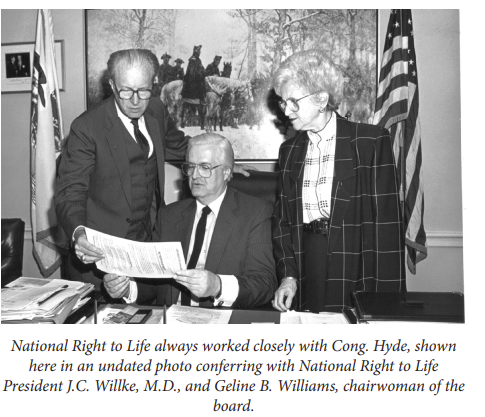
As pro-life titans go, who could ever surpass Rep. Hyde? The Abortion Industry has bashed its head against the against-all-odds victory he spearheaded for almost 50 years.
When Rep. Hyde passed away in 2007, the entire Movement praised his enormous contributions. It’s easy to see why, as NRLC once explained:
Henry Hyde will be remembered by history as the father of the modern pro-life movement for his introduction and sponsorship of the amendment that bears his name, prohibiting federal funding of abortion. Hyde first offered the amendment as a freshman member of Congress in 1976, and it remains in place to this day. The editors of National Review said the Hyde Amendment “is without question the most important piece of pro-life legislation ever to pass Congress.”
The Hyde Amendment also charted a new course for the pro-life movement after 1976 by implementing a strategy to pass protective pro-life measures that would incrementally reduce the number of abortions, while continually seeking the eventual overturn of Roe v. Wade. That strategy has been successful in saving millions of lives from abortion.
Finally, Rep. Hyde’s best-remembered commentary on abortion is this passage, familiar to millions of pro-lifers:
When the time comes as it surely will, when we face that awesome moment, the final judgment, I’ve often thought, as Fulton Sheen wrote, that it is a terrible moment of loneliness. You have no advocates, you are there alone standing before God and a terror will rip through your soul like nothing you can imagine. But I really think that those in the pro-life movement will not be alone. I think there will be a chorus of voices that have never been heard in this world but are heard beautifully and clearly in the next world and they will plead for everyone who has been in this movement. They will say to God, “Spare him because he loved us,” and God will look at you and say not, “Did you succeed?” but “Did you try?”