
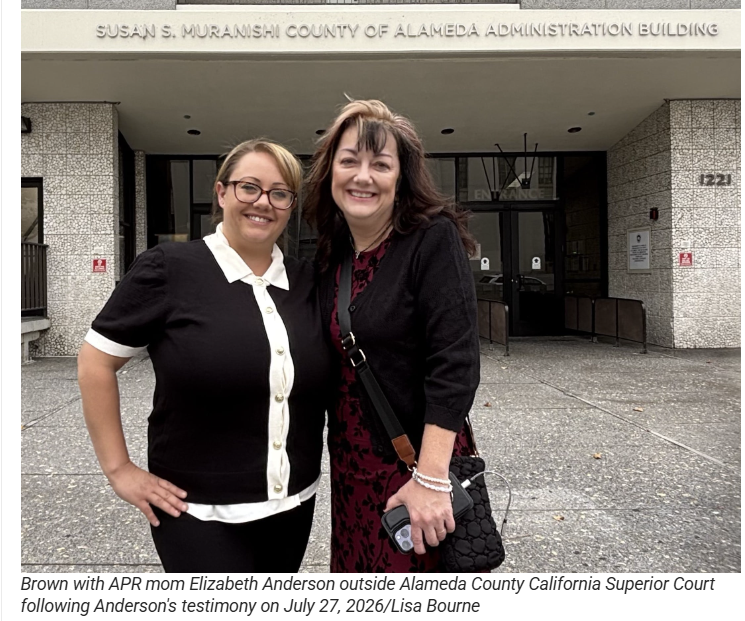
By Lisa Bourne
When Christa Brown was questioned on the stand whether she was nervous to testify in the first Abortion Pill Reversal case to go to trial in the U.S. she answered in the affirmative.
Asked why she was nervous; Brown’s response provided perhaps the most dramatic moment in the trial for The People of the State of California v. Heartbeat International & RealOptions.
As Senior Director of Heartbeat International’s Medical Impact team and Executive Director of the Abortion Pill Rescue Network (APRN), Brown is a regular witness to the roughly 200 women who call the APRN each month after starting a chemical abortion, now seeking to sustain their pregnancies and start the Abortion Pill Reversal (APR) process. Heartbeat manages the APRN.
Her roles also meant she was questioned at length during the trial about the APRN’s statistics, internal and external communications, training, policies, procedures, and related media appearances.
But it was Brown sharing in the final days of witness testimony why she serves women and families in pregnancy help and APR, and why she was anxious about testifying in the trial, that got to the heart of the life-and-death matter now going before a judge.
A second chance at choice on trial
The State of California, through Attorney General Rob Bonta’s office, is endeavoring via the case to prove Heartbeat and its affiliate RealOptions Obria Medical Clinics have engaged in false and misleading commercial speech by saying APR is safe and effective.
Bonta seeks some $20 million in penalties and to bar Heartbeat and RealOptions going forward from making certain statements about APR, including from using the term “reverse” to describe it.
Chemical abortion consists of two drugs, mifepristone, which blocks progesterone, a hormone necessary to sustain a pregnancy, followed by misoprostol, taken a day or so after the mifepristone, which prompts the mother to go into labor and deliver her often deceased child.
APR entails prescribing bioidentical progesterone to a woman who has taken mifepristone to counter the abortion drug’s effects. The protocol is an updated application of a treatment used since the 1950s to combat miscarriage.
All major studies show that using progesterone to counteract an in-progress chemical abortion (Abortion Pill Reversal) can be effective as it’s bio-identical to the hormone a woman’s body produces to sustain her pregnancy. A 2018 peer-reviewed study showed positive results, with 64%-68% of the pregnancies saved through Abortion Pill Reversal, no increase in birth defects, and lower preterm delivery rate than the general population.
Statistics show that to date more than 8,000 lives and counting have been saved thanks to the APRN, a network of nearly 1,500 healthcare professionals, pregnancy centers, and hospitals that administer APR.
Actuality
Bonta’s office has conceded that it has received no complaints from women about APR.
Additionally, the testimony of the State’s lead expert witness, abortion doctor Mitchell Creinin, raised significant questions about the reliability of the study around which the state’s case is built. Among other things, Creinin admitted under oath that no component of APR is known to cause birth defects and could not testify that APR doesn’t work or that it’s unsafe.
More than 200 women who sought assistance through the APRN signed an open letter in late June conveying gratitude for the care, information, and the hope they received from the APRN. More than 40 of the 200-plus women are from California. Many of the women sent photos of their children, from ultrasounds in the womb of current pregnancies to children of adolescent age.
The AG’s legal team had objected to the defendants’ inclusion of photos of babies born after the APR protocol in case materials arguing they were “irrelevant.”
“This case could affect if help will be available to these women”
A few of the women who signed the open letter also sent extra letters voicing gratefulness. Two of these were introduced as evidence in the trial, though only allowed to support Brown’s state of mind, not evidence of APR’s effectiveness.
After questioning Brown about the letters counsel for the defendants asked her whether she was nervous and why.
“It’s my understanding that this case could affect if help will be available to these women,” Brown said.
She then had to pause to process her emotion, after which she apologized to the court.
“It’s very important to me that they have — if they have help available to them in that moment,” Brown said.
“I’m so sorry,” she said again, emotional, the effect resonating throughout the courtroom.
“And it’s — I believe it would be a tragedy if even one woman completes an abortion that she no longer wants or no longer consents to,” said Brown.
“I think it’s very important, the work that we do,” she said. “And the effect that this case could have on women throughout the country could be devastating to them.”
Counsel for the AG was quick in subsequent questioning of Brown to produce acknowledgement that the AG’s lawsuit contained no claim against the provision of APR, rather certain statements about it.
Brown responded it was her understanding that the outcome and penalties could result in prohibiting APR from happening.
Tweet This: I believe it would be a tragedy if even one woman completes an abortion that she no longer wants or no longer consents to – Christa Brown
Earlier in her testimony Brown had been asked about her background and how she came to her roles at Heartbeat and overseeing the APRN and its hotline.
Brown, an RN and BSN, had worked in labor and delivery in a hospital, she had been Director of Nursing for an organization, and managed two WIC (Women, Infants and Children nutrition program) clinics simultaneously.
She got her start in pregnancy help in 1995 as a volunteer and eventually became the director of three pregnancy help medical clinics concurrently, two in Indiana and one in Michigan.
“So, my heart has been with this ministry for a long time,” Brown testified. “And I do feel like I am pulled by God to do this. It’s been a great honor to be in this work for so long.”
It was while she was serving in pregnancy help that she went back to school and earned her RN and BSN degrees.
Overcoming difficulty to choose life
Brown is like many in the pregnancy help movement – moved to serve others in the ministry because of personal experiences with unplanned pregnancy.
She shared in court how her first pregnancy was unexpected when she was a freshman in college.
“I had a very different life that didn’t really correspond with being a mother at that point, of course, and I had to make a lot of difficult choices,” she said.
She discussed how this experience involved hard choices and shaped her commitment to be there for women and families through pregnancy help and APR.
Brown and the baby’s father chose life and parenting. The tough choices they made were compounded by a difficult pregnancy that required some bed rest. The couple moved from South Florida back to Indiana, hoping for more support. But they didn’t get the support that they had hoped for and things remained hard financially. Brown said this period was sad, difficult, and dark for her.
“It was a challenging time,” she told the court. “And then when I had my son, I probably felt even more insufficient because they handed me a perfect child, and I was anything but perfect.”
Brown said during this time she became a Christian and realized that God would help her and supply her needs.
“But more importantly,” she said. “He helped me understand that there might be others that might need help.”
As the time passed things got better, Brown said. She was married and had more children.
Being there for women and families
“I realized there probably were others out there that maybe felt the same way that I did, that maybe they needed support,” she said. “Maybe they needed someone to talk to, maybe they needed just somebody to sit with them.”
And so, Brown found a small local pregnancy center and asked if there was anything she could do. The answer was “yes.”
For the first four years she cleaned the bathroom, greeted clients, answered the phone, and folded clothes.
“I just did whatever they asked of me,” Brown said. “And I really fell in love with the work because it supports families in such a real way, and just sort of becomes what they need in that moment.”
“And so, my initial pregnancy, my first pregnancy sort of drew me to this work,” Brown testified. “But really, working with these women and these families for so many years is what really has kept me in this work.”
“It’s been an honor and a privilege to sit with thousands of them as they made really difficult choices,” Brown said.
Closing arguments in The People of the State of California v. Heartbeat International & RealOptions are scheduled for September 17 and a ruling from the judge is due within 90 days of that date.
Heartbeat International manages the Abortion Pill Rescue® Network (APRN) and Pregnancy Help News where this first appeared. Reposted with permission. Heartbeat is currently the subject of two lawsuits brought by state attorneys general concerning sharing information about Abortion Pill Reversal.