
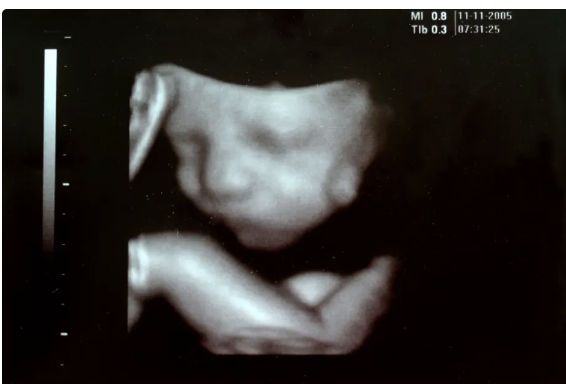
Or so these activists would have us believe
NARAL and Preborn Babies
By Sarah Terzo
In a previous Substack article, I wrote about how the pro-abortion group Reproductive Freedom for All, then known as NARAL, sent out a fundraising letter in 2015 that referred to a child in the womb as a “baby.”
The letter urged readers to donate to NARAL to help them fight against Bill HR 36, the Pain-Capable Unborn Child Protection Act, which would have banned abortions after 20 weeks.
Dana Weinstein, who aborted her baby after she was diagnosed with a potentially fatal condition in the womb, wrote it. She says:
When I was more than 20 weeks pregnant, my doctor discovered our baby had horrifying severe fetal anomalies that could not have been discovered earlier in pregnancy.
If I’d carried our wanted and loved baby to term, she would have survived only for a short time, in a world of immense suffering. So, we chose to end our baby’s pain.
One phrase in the letter seems to reveal exactly why the pro-abortion activists at NARAL were willing to acknowledge the humanity of Weinstein’s daughter. Weinstein refers to her baby as “much loved and wanted.”
Many pro-choice people seem to recognize the humanity of babies in the womb when they are wanted, but consider unwanted babies to be less than human.
This selective view of reality is why you never hear expectant mothers who are happily pregnant refer to their baby as a “fetus” or “lump of cells.” People have baby showers, not pregnancy tissue showers. When people, even pro-choice people, show off their ultrasound photos, they don’t say, “This is my product of conception.”
When a pregnancy is desired, they skip the euphemisms and call their preborn child a “baby.” They accept her humanity.
This is so common that it is almost universal. Even abortionists do it.
An Abortionist and Her Baby
Abortionist Christine Henneberg wrote a book about having a baby while working as an abortionist. She committed abortions throughout her pregnancy.
Even though she considered the babies she killed to be less than human, she believed her own preborn child was a baby. In her book Boundless: An Abortion Doctor Becomes a Mother, she wrote:
In abortion care, a 16-week fetus is not a child. But this life inside of me – it is a child. It is my child.
Henneberg aborted a 16-week-old baby while she herself was 16 weeks pregnant. The abortion was supposed to be a D&E, where the baby is pulled apart with forceps and removed, piece by piece. But the child came out whole, and Henneberg saw him or her move.
Henneberg recalls, “It was all I could do not to vomit, to run from the room crying.”
Unfortunately, she didn’t stop doing abortions.
Justifying a Double Standard
In their 2024 book, I’m Sorry for My Loss: An Urgent Examination of Reproductive Care in America, pro-abortion authors Rebecca Little and Colleen Long attempt to rationalize this way of thinking.
They say that some women:
may have been relieved by an abortion when they were young and unprepared and didn’t think about it at all but later grieve for months over a failed IVF embryo transfer.
Though some struggled with how to reconcile those feelings with personal politics, it made sense to them that they would feel differently about each pregnancy.
Because every pregnancy is different, even when they’re all successful, because of life circumstances. For example, you don’t get to nap with that second pregnancy if you have a toddler in the house.[i]
Life circumstances can definitely affect how you feel about something or someone. But what does whether you can nap when you’re pregnant have to do with when life begins?
Little and Long say:
[H]ow you relate to the pregnancy determines your attachment and experience with it. The end. No politics, no further expectations.
This way of thinking supports abortion as a morally valid choice and also allows pregnant people to consider the fetus inside them a baby without contradicting one another.[ii]
But how can abortion be a morally valid choice if the “fetus” is a baby? How can killing a baby ever be a moral choice?
Little and Long go on to explain that, in fact, a fetus is only sometimes a baby.
They quote anthropologist Lynda Layne, who claims that since “personhood is culturally constructed,” it “may be undertaken with some embryos and not others.”[iii]
Apparently, there’s a name for the process of turning a fetus into a baby. According to Little and Long, “feminist bioethicists” refer to it as the “calling into personhood.” They explain that “the fetus does not have inherent personhood; someone else has to draw it out.”[iv]
Who is invested with this godlike power to turn a nonperson into a person with human rights and intrinsic worth? According to Little, Long, and Layne, it’s the baby’s mother.
Little and Long write:
The relationship is bestowed by the pregnant person, not necessarily by biological stages. If a pregnancy is unwanted or unable to be kept, or if a person with recurrent losses is trying to protect their own feelings, this may be delayed or never happen at all.[v]
Never happen at all? Even after birth? Are there humans walking around, talking, forming relationships, living their lives, who are not, in fact, people, because their mothers never “called them into personhood?” Some babies are discarded or abandoned. Sometimes these babies are found, adopted, and raised in loving homes.
But their biological mother never valued them. So, are they not people? Should it be morally permissible to kill them?
Little and Long then say:
This explains how much-wanted but failed embryo transfers are devastating, how a miscarriage that ends a pregnancy with a terrible partner can be a relief…
It also gives a name to something that many pregnant people know to be true – they’re perfectly capable of being excited by their own ultrasound without subscribing to or even being interested in antiabortion rhetoric.[vi]
That they are not “interested” in pro-life “rhetoric” and are “excited” by their ultrasound pictures doesn’t influence whether a baby in the womb deserves the right to live.
Their “interest” and “excitement” don’t work to confer or deny preborn babies human rights. Feelings don’t change facts, and they don’t determine human worth.
Pro-Choice Women’s Perceptions
Little and Long quote Kelsey Garcia-Abdin, who, after several miscarriages, attempted to conceive via IVF. She lost an embryo who was unable to implant. (Aside: My grammar-checking program ProWritingAid recommended I change “who” to “what” to refer to an embryo. No, software developers, the proper word is “who.”)
Garcia-Abdin talked to the authors about how the words “products of conception,” when used by doctors, failed to capture her pain at losing her children. Then she admits:
I struggle with how to talk about my embryos. A lot of people have trouble seeing that embryo as a baby, but for me, that’s all I see. I have such a strong connection to them because I had so much hope that they would be born.[vii]
Later in the book, Little and Long quote Garcia-Abdin again:
I would never tell my friend who had an abortion that she killed her baby. But I would never want her to come to me and tell me my embryo is not a baby. And I just don’t see the problem there. It’s up to the individual to decide what it means to them.[viii]
But does what an embryo “means” to someone change what or who that embryo is? No. Regardless of how you, I, or anyone feels about a specific object, being, or person, the nature of the object, being, or person doesn’t change.
No one has the power to confer personhood on someone else (or take it away) based on their feelings about them. A person’s human identity, inherent worth, and basic human rights aren’t dependent on whether someone else values them. They are inherent in who they are.
Little and Long tell the story of Catherine and her partner and their multiple pregnancies with IVF.
Catherine (last name withheld) tried to have a baby via IVF. Her first embryo, a daughter, went to term and was delivered by emergency C-section. Her second pregnancy through IVF resulted in a miscarriage. Six months into her third pregnancy, also conceived via IVF, she contracted COVID, which led to preeclampsia. Doctors had to deliver her second daughter early, at 24 weeks. Born alive, the baby grasped and held her mother’s hand. Sadly, the child died after three days.
Catherine and her partner, a trans man, had six embryos left, and since he had a uterus, the couple decided to proceed with him taking over as the gestational parent. After three failed transfers and one ectopic pregnancy, the couple had a second, healthy child.
Little and Long quote Catherine saying:
I work in reproductive rights. I have been attached to our embryos, and we mourned when they didn’t stick. Watching our daughter grow up knowing she was an embryo makes them mean something in a new light.
But I guess the difference to me is this was our intentional choice. It was our choice to transfer and gestate those embryos and carry them to baby. If it was not our intentional choice, it wouldn’t have meaning to me.vii
Again, whether an embryonic person has “meaning” to his or her mother doesn’t determine his or her worth. Nor is the choice to have a baby what makes that baby a human being.
An Arrogant, Self-Centered Philosophy
There is a certain amount of arrogance in the position of Little, Long, Layne, and Catherine. A sense of playing God. They are essentially saying to their children: You are important to me; therefore, you are a human being with rights. If you weren’t important to me, you wouldn’t be human. You would be worthless, and it would be morally permissible to kill you.
It’s a self-centered, self-important view that assumes that only what is important to ourselves has value and anything else can be destroyed. It should be noted that only the mother’s feelings for the baby matter. The father, the grandparents, pro-lifers, society – whether they value the child means nothing. Only the mother’s feelings count.
The concept of “calling into personhood” or whatever one calls it is illogical, irrational, and self-serving. It ultimately works to justify the deaths of human beings who have worth, regardless of whether their mothers value them.
[i] Rebecca Little and Colleen Long, I’m Sorry for My Loss: An Urgent Examination of Reproductive Care in America (Naperville, Illinois: Sourcebooks, 2024) 293.
[ii] Ibid., 293.
[iii] Lynda Lane Motherhood Lost: A Feminist Account of Pregnancy Loss in America (New York: Routledge, 2005), Chapter 10, Kindle edition
[iv] Rebecca Little and Colleen Long, I’m Sorry for My Loss…, 293
[v] Ibid., 293-294
[vi] Ibid., 294
[vii] Ibid.,9
[viii] Ibid., 293.
viii. Ibid.
This appeared on Sarah’s Substack and reposted with permission. You can read more of her articles here.